Sunday, April 8, 2012

My DAW System Specifications

UPDATE: There's a newer post listing the latest specs of my setup.

I'm going to be doing a number of posts about producing digital music, and this post just serves to list what hardware and software I'm using for my digital audio workstation, so I can refer to it whenever I need to provide context. As of the time of this writing (April 2012) my home-built desktop DAW PC is a little over two years old. I selected just about every physical component explicitly for its impact on music production. If you manage to accumulate the same parts or better, you're going to be in good shape.

PC Hardware
  • Processor: Intel Core i7-950 @3.06 GHz (Bloomfield family, 4 cores, 8 threads). I'm using the factory heat sink.
  • Motherboard: Gigabyte GA-EX58-UD5. Plenty of room and plenty of slots. Also has Texas Instruments FireWire, which is considered to be the best chipset for digital audio. Socket 1366 supports Intel Gulftown and Bloomfield processors.
  • Case: Antec P183. Quiet and sturdy with isolated areas for power supply and hard drives, to reduce noise. I'm using the fans that came with the case.
  • Hard drives: Three Western Digital Caviar Black drives, at 7200RPM @ 500 GB. Quiet, fast drives. One for operating system and applications, one for samples and VST libraries, and one for projects and recorded data.
  • Power Supply: Corsair HX650. Relatively quiet, with all the power this computer will ever need. Wonderful modular cabling; you only use exactly the number of wires you need.
  • RAM: Two Kingston DDR3 1333 sticks @ 6 GB each, for 12 GB total.
  • Wireless: Linksys WMP600N Wireless-N PCI Adapter with Dual-Band. Reliable connection, with good range.
  • Optical: Plextor PX-B320SA Blu-ray Disc Combo. BD reader, and super multi writer.
  • Video: EVGA NVIDIA GeForce GTX 570. This is a more recent card, and while it's super powerful for gaming, you can probably find quieter cards for digital audio. You can likely get by on a very low-end, fanless card.
Audio Hardware
  • MIDI Controller: Akai Professional MPK49. This controller has nice semi-weighted keys, runs off USB bus power, and includes programmable knobs, sliders, transport controls, and drum pads. It also includes templates for using it with Ableton Live and Cubase.
  • Audio Interface: Mark of the Unicorn (MOTU) UltraLite-mk3. Mine is the pre-Hybrid version that only has FireWire 400. (Even though USB 2's top throughput is higher than FireWire, all the device contention you typically have on a PC with USB keyboard, mouse, and MIDI devices, makes FireWire the better option.) The device draws power from the FireWire interface, but includes an optional power adapter.
Software
  • Operating System: Windows 7 Professional 64-bit, with Service Pack 1. The 64-bit version of Windows 7 delivers the best balance between power and performance, and gives you access to as much RAM as you're able to cram into  your computer. Note that not all DAWs or VSTs are fully 64-bit compatible yet, but you can usually run the 32-bit versions on 64-bit Windows with no problem.
  • DAW: Steinberg Cubase 5.5.3. The curent version is 6.5. I've been a cubase user since the very first release on Mac in 1994, although the Cubase of today is wildly different from the MIDI-only Cubase of the early 90s. I purchased version 5.0 and had to run various patches (5.1.1, then 5.5.0, then 5.5.3) to bring it up to date. I am using the 64-bit version, and most of my VSTs have 64-bit versions.
  • DAW: Ableton Live 8. I got a free version of this with the MPK49, which included a very nice discount for upgrading to the full version. I am a total Ableton n00b at this point, but it's a very popular DAW, and most online digital music production tutorials these days seem to use it. I don't understand why they don't have a 64-bit version yet, though.
  • VST Instruments: Native Instruments Komplete 6. The current version is Komplete 8. This is a suite of the most popular Native Instruments packages, including samplers, synths, and drum machines. It is a pretty mind-boggling and overwhelming set of software, and I have barely begun to comprehend it all. Most of the VSTs offer both 32-bit and 64-bit versions.

Wednesday, February 1, 2012

Worst Purchases of 2011


These days, when the cost of just about everything seems to increase faster than our annual raises are able to cover, it really stings when we invest time and ever-more-precious money into a product or service that falls short of expectations. These four things I bought in 2011 didn't just fall short; they did a full-on Chevy Chase faceplant into failure. I'm calling them out here to highlight the very specific mistakes these manufacturers and service providers made, and to also recommend some alternatives that worked out for us in the end.

HP Photosmart e-Station C510a
Our requirements for a replacement for our previous HP printer were pretty straightforward:
  • We wanted it to have wireless support, so we didn't have to leave a computer powered on 24/7 for other PCs in the house to print on it.
  • It needed to scan and make copies.
Of course, it should also print- but we just sort of took it for granted that a printer would do that. Who would ever make a printer that wouldn't print?

The thing is, the HP software required to send print jobs from the various PCs in the home to the printer sucks. Sometimes it crashes, sometimes it can't find the printer, and sometimes your print jobs just vanish into the aether. It's quite possible that the directions to a Cub Scout meeting that my wife repeatedly attempted to print landed on the output tray of some hapless HP owner in Namibia. We will never know.

Something that seemed neat at first but turned out to be awful is the printer's touch-screen control panel (irritatingly called the "Zeen"), which is actually a detachable Android tablet. It's a thick, sluggish, artificially crippled Android tablet, but at least you can (slowly) browse the web from the toilet with it. (As long as you don't need Flash.) Problem is, the tablet failed at its primary job of operating the printer. Half the time it didn't realize it was docked on the printer. The rest of the time it openly defied any of my wife's attempts to make it do anything related to printing, scanning, or copying. Oh, and every couple of weeks it randomly lost all of its settings, requiring me to run through the setup wizard in order to make the printer "work."

What we bought instead
The Canon Pixma MX882 Wireless Office All-in-One Inkjet Printer. This thing does everything the HP claims to, without requiring you to reboot your computer or re-run initial setup procedures every time you need to use it. The support software is a little clunky, but it works.


Safe Eyes
My son and daughter are blossoming nerds, and the Internet is a vital and regular part of their lives. Unfortunately the Internet is dangerous for kids anyone with eyes, so we needed a way to give our kids access to the sites and programs they needed while completely blocking out the rest of the web. Safe Eyes seemed to do the trick at first. We set up a whitelist (where you explicitly specify which sites the kids are allowed to access) and I used a network sniffer to determine which sites the kids' online games (Minecraft, Roblox, Toontown Online, and Lego Universe) needed to access.

Wait... why in the hell did I have to set up a network sniffer? How many parents even know what a network sniffer is? Well, funny thing- Safe Eyes only seems to understand traditional browser traffic. It doesn't quite know what to make of the proprietary protocols that games tend to use, so it just quietly blocks them. Problem is, it doesn't record which sites it's blocking when this happens like it would if you attempted to browse to a blocked website in Firefox. And there's no way to whitelist at the application level; in other words, you can't tell Safe Eyes "never block traffic from this program." (You might find a couple of technical articles explaining that this is possible, but those articles are wrong. You can only block applications in Safe Eyes, not allow them.)

Unfortunately, online games are dynamic; they can add new servers and change content providers and file hosts in the background any time you log in. Every couple of weeks one or more of the kids' games would break again, and I'd have to set up the sniffer and figure out which new sites we needed to add to the whitelist.

But there was another problem! Since Safe Eyes doesn't "get" online games, if a kid played a game for more than 15 minutes, Safe Eyes would mistakenly assume that no one was using the Internet and quietly log out, blocking ALL Internet access on that PC. This is not a documented feature, and there is no way to keep Safe Eyes from doing it. (Actually, I wrote a little program that randomly connects to various web sites in the background to trick Safe Eyes into thinking someone was using the Internet. Again, how many other parents would be able to do this, and why should they have to anyway?) It really screws up games, too; my son would just spontaneously lose his connection in the middle of a quest, and have to quit his game, sign back in to Safe Eyes, and log in to the game again, typically losing progress in the process.

Oh, their support sucks too. Email support never wrote back to me the two times I contacted them, their overseas phone rep had zero idea what he was talking about, and there is no forum for customers to help each other.

What we bought instead
NetNanny does everything Safe Eyes does, in addition to allowing you to explicitly whitelist applications. All of the kids' games simply work. It also doesn't time out in the middle of gameplay. I had a problem the first time I installed it on one of the computers (it accidentally blocked all Internet access!), but I cleaned up the system and managed to get it to work right on the second install. Their web site is pretty dodgy (even moreso now, after a recent redesign), but the product mostly works. I'm trying to figure out a problem that seems to prevent my son from running a Minecraft server accessible only on our local network, but that's a low-priority issue. There is (or at least was?) an official support forum, but I'm having trouble getting to it on their new site. I'm watching you, NetNanny. Don't let me down!

Sony MDR-NC 40 Noise Canceling Headphones
Here's an electronics marketing protip: If a major selling point of your product is part of the thing's name ("NC," "Noise Canceling"), the product should have that feature. Even if it does a crappy job of it, the product should at least try to do what it's named for, yeah? These headphones don't.

I needed a pair of noise cancelers for when I watch my iPod at the gym. All those treadmills make it mighty hard to hear Dexter Morgan mumbling his voiceovers. These headphones are comfortable and they sound all right for consumer-grade 'phones, but the only ambient noise they block is accidental, due to the fact that the pads cover your ears- not because of any fancy circuitry. There's a little module in the middle of the headphone cable (which is a real annoyance for something you're using at the gym) that houses a battery which seems to serve the sole purpose of illuminating a red LED.

Other complaints: The headphones feel flimsy; all of the joints have more wiggle than seems necessary. They are supposed to collapse small enough to fit into this cute leather pouch they come with, but my pair doesn't fold all the way in the center, so I have to forcibly jam the things into the pouch to zip it up.

What I bought instead
The Bose QuietComfort 15 Acoustic Noise Cancelling Headphones are pricey but they do exactly what you expect them to. When you flip the switch (which is on the right earpiece instead of a stupid dongle on the cable) the sounds of what's going on around you quickly fade into the background. They also feel great and so far have demonstrated pretty good battery life. Note that these headphones don't work at all without the battery, so you'll want to keep some AAAs on hand.
I also own a pair of Audio Technica ATH-ANC7B Active Noise-Cancelling Closed-Back Headphones, which I use at work (long story). They're half the price of the Bose, but honestly just as good-sounding- and they at least work a little bit when the battery runs out (but they sound much better when powered).

HTC Status

The Status is AT&T's version of the HTC Chacha. It appealed to us because we were total smart phone n00bs who'd finally outgrown our ancient flip-phones, but were apprehensive about these new-fangled touch screens. We wanted real physical buttons for texting and dialing, and the Status's Facebook integration was desirable.

Reviews I'd read before selecting the phone mentioned that the 150MB internal storage was pretty small, but I figured that wouldn't be an issue since I knew AT&T included a 2GB SD card with the phone. We could just move stuff off to the SD card as needed or uninstall unnecessary apps to free up space, right? Right???

Well of course, now we know better. AT&T locks the phone down so you can't move or uninstall any of the bundled apps. You basically only have about 40MB total for downloaded apps and personal data. After about 3 weeks of use my phone stopped downloading calendar updates, email, or Facebook statuses. Forcing sync never seemed to do anything. Also, my phone kept telling me I was out of room... but it wouldn't let me do anything about it! A couple weeks after our 30-day exchange window ran out with AT&T I spent a week learning how to root ("jailbreak," unlock) my phone so I could delete some of the things I knew I would never need. That worked at first, but rooting had unexpected consequences: If I turned off the phone and then plugged it in to charge, the phone wouldn't power up again unless I opened it up and removed the battery (which is a non-trivial task on this phone with its smooth, cornerless body). Also, it no longer displayed the battery charging screen when in standby, and the keyboard layout was permanently messed up- I had to use the Symbols screen to type @ signs or question marks. And then the phone started telling me I was out of space again.

Also, the Netflix support sucked; the audio was hopelessly out of sync with the video, even on a WiFi connection. Seriously, fuck this phone.

What we got instead
Since we were no longer eligible for subsidized phones from AT&T, I did serious homework when researching our next phones, because this time we were going to be paying full price. We ended up choosing the Samsung Galaxy S II 4G Android Phone. Aside from the power and volume controls, it doesn't have any physical buttons, but boy do I ever love this phone. It's fast, refined, and it just plain works. Actually dialing the phone is a bit easier on this than on the Status, because the virtual keys are nice and fingertip-sized, whereas the teeny buttons on the status were hard to use in situations where you had to type numbers for automated phone menus. Oh it also has literally 78 times more internal storage than the HTC Status. Our phones are specifically the SGH-I777- they actually look just like the newer Galaxy S II Skyrocket, but lack that phone's faster processor and LTE support.
Here's hoping 2012 treats us better.

Monday, July 25, 2011

Ten Great Episodes of WTF with Marc Maron

Even if his name doesn't ring a bell, chances are you've seen or heard stand-up comedian Marc Maron at some point- whether it was during one of his many appearances on Letterman or Conan, one of the episodes of Short Attention Span Theater he hosted on Comedy Central, or when he was a radio personality for Air America. Since 2009 he's produced a podcast, WTF with Marc Maron, where he interviews notable comics, comedic writers and actors in his garage studio, inviting them to speak candidly about their successes and struggles. These are not softball press-junket interviews, nor are they hard-boiled confrontational ambushes. Marc's openness about his own insecurities and flaws seems to evoke genuine introspection from his guests, resulting in interviews that appear to surprise Marc and his subjects as much as anyone listening.

The format of each show is consistent. Marc begins with a "riff" which may or may not be intentionally funny, and sometimes ties in with the subject or theme of that show's interview. The interview follows, and after that Marc usually caps the show with some post-interview observations. It's almost always worth listening all the way through. While Maron has scored some major celebrities in the show's short life (including Louis C.K., Robin Williams, and Ben Stiller), his best shows aren't always the ones with the best-known guests. The interviews that really leave an impression are the ones where people lay themselves bare, admitting their mistakes and imperfections, or where they relate amazing or unusual stories from their lives.

There are occasional "live" episodes where Marc interviews several comedians in front of an audience. These interviews are necessarily shorter and shallower, but are frequently amusing, at least.

All of the show's episodes are available online in some manner, although the options for listening to them vary depending on how old the show is and who the guest was. Older shows with particularly famous guests usually end up as iTunes album downloads called "WTF Premium" shows, which are available for a price. Shows too old to be cached in iTunes' free podcast directory are available for streaming through the WTF mobile app, or by subscribing on the official site. I link to the most convienient/affordable means of obtaining each of the below episodes. You can also refer to the show's episode guide for a complete breakdown.

Note: Aside from the WTF Premium episodes available from the iTunes Store, I've only heard episodes back as far as 124 (Paul Scheer). There are certainly some gems in the first non-premium 123 episodes that I have not yet uncovered.

75. Carlos Mencia
76. Willie Barcena, Steve Trevino, and Carlos Mencia
The first entry in this list is kind of a cheat since it's technically two episodes, but you get the point. Most people who follow Comedy even casually remember the controversy when Joe Rogan and others publicly accused "Carlos MenSTEALia" of lifting material from other comedians. In episode 75 Carlos addresses the problem directly and with a humility that convinced me, while listening, that people were overreacting to the scandal. But Marc closes that show with his own doubts and some telling details that he hadn't revealed during the interview, which shed doubt on Mencia's story. Things become much more interesting in the following show where Maron interviews two comics with specific and alarming details about Mencia's antics, and then gives Mencia a chance to respond to the new criticisms. I almost guarantee you'll come away from this second part with a totally different perspective than after the first one.

130. Mike DeStefano
Listeners first got a taste of Mike DeStefano in a short and hilarious live interview Marc had tacked onto the end of episode 129 (Janeane Garofalo). In this long-form studio interview, though, we get a much clearer understanding of why so many people in the business love Mike DeStefano. His honesty, strength, and love for life are just as appealing as his sense of humor. Very few people have lived through the horrors and struggle this guy has, and almost none of them managed to cling to their humanity as he did.

This interview was recorded and published in late 2010. After listening to it, fast-forward to episode 156 (Kathleen Madigan) for a heartbreaking epilogue in Marc's opening riff.

145. Gallagher
You don't have to search very hard for evidence that lowbrow prop-comic Gallagher is an insecure and bitter old man. So it's not surprising that Gallagher comes off as an evasive ass in his WTF interview. You get a very clear sense that Gallagher didn't know what he was getting into when he agreed to appear on the show, and probably didn't even know what a podcast was. This is not to say that Marc was overly confrontational; it's just that Gallagher seemed to expect it to be your average Morning Zoo kind of fluff whereas Marc was ready to discuss some specific criticisms about Gallagher's act. This is, I believe, the shortest WTF interview because Gallagher walked out halfway through. "Aw, c'mon Gallagher" has become an unofficial WTF meme.

146. Dave Foley
One of the most likeable characters from The Kids in the Hall and News Radio, Dave Foley had an enviable life and career for several good years. But after the agents stopped calling and problems at home started escalating, the likeable Canadian's life took a number of dark turns. Foley details his woes in good humor if not good spirit, charting the course of his life from promise to desperation.

147. Stephen Tobolowsky
The prolific character actor Stephen Tobolowsky has featured in over a couple hundred movies and shows since the Seventies. His career has taken him to interesting places, and in this interview he shares a number of amazing and inspiring stories. After hearing this show it should make sense that Tobolowsky has his own podcast.

151. Carl LaBove
While he's never even approached household name status, Carl LaBove is well-known in stand-up circles, and was one of Sam Kinison's closest friends throughout that comic's entire tumultuous career. Marc Maron actually has some history with both Sam and Carl, some dark and traumatic times which still haunt him. He confronts Carl about their shared past and delves deep into Carl's own troubled friendship with Sam. Listen very closely to this one; it gets heavy.

173. Jonathan Winters
I've got to admit, ever since I was a kid I never liked Jonathan Winters. The first I ever saw of him was when he played that adult baby on Mork and Mindy. Well the fact was that I was just too young to get Winters; he won me over in this interview. Marc traveled to the 85-year-old Winters' home to record the interview, and it's just astounding how easily the old guy drifts into character and riffs between fielding serious questions. It's just as delightful to hear Marc cracking up every few minutes whenever Winters goes into a bit. If I remember right Marc also tells a great little story in the closing comments about a tour of the house Winters took him on which shows what a pure and youthful heart that man still has.

174. Sally Wade
Sally Wade was George Carlin's long-time partner. They never married, but they shared a magical, storybook-romantic relationship for many years. This interview illuminates a side of Carlin that no one else ever saw. It's a heartwarming (and breaking) tribute to the man she loved.

190. Todd Hanson
This episode was recorded as two separate interviews a few weeks apart. A longtime writer and editor for The Onion and a longtime friend of Marc Maron's, Todd Hanson tells the story of The Onion's early days and its ultimate effects on the world of Comedy. The first interview is easy-going and light-hearted, even though both Marc and Todd allude to something more ominous without going into detail. Things are made clear in the second interview, where Hanson lifts the curtain on some life-altering events and analyzes their impact on everyone he knows. You might never hear another person who's not an immediate family member speak so honestly about something so painfully private.

194. Rob Riggle
I envy the opportunities Marc Maron has to get interesting people to talk openly about interesting things. Rob Riggle is a Lieutenant Colonel in the United States Marine Corps Reserve, and at a broad-chested 6'3" is about the least likely guy you'd expect to find working with some of the best minds in comedy. He's appeared on Upright Citizens Brigade, Chappele's Show, Saturday Night Live, Human Giant and the NBC version of The Office. He talks about his career in the military, including working Search and Rescue detail at Ground Zero after the September 11 attacks. A hard-to-pigeon-hole guy with a fascinating career.

Saturday, July 9, 2011

Home Is Where the Hot Is


In the late Sixties, my parents moved to Guam, the southernmost of the Mariana Islands, to teach local children in English-speaking schools. They worked under a program that brought educators from the mainland to this tropical United States territory, and remained there for several years- until just a few days after I was born. This summer, my parents kept a long-standing promise to take me back to my birthplace, showing me the island where their young marriage was forged.

The island is remarkably remote, closer to the Philippines and Papua New Guinea than to any part of the United States. Guam’s indigenous people, the Chamorros, thrived on the island for nearly 4,000 years before Magellan discovered the place in the 1500s, at which point their fortunes would change. The Spanish conquered and converted the local population for hundreds of years until losing the island to the United States after the Spanish-American War. The Japanese captured the island mere hours after the raid of Pearl Harbor, committing unspeakable atrocities against the Chamorros. Three years later, the United States bombed the shit out of the island, ultimately winning it back from its Axis foes and making Guam a remote stronghold for both the Air Force and Navy; a military presence deep in the Pacific.

While Guam’s people were exploited and exterminated by other nations, its wildlife was ravaged by invasive species, both plant and animal. The only birds you’re likely to see on the island now are sparrows, stowaways from visiting ships long forgotten. The indigenous birds were almost completely wiped out by the brown tree snake, another invader from foreign lands- so new to the island that the local species had no instinctive fear of the serpent. Almost gone as well is the once prolific fanihi, or Mariana fruit bat- formerly a local delicacy, but now a protected species.

Wondering why Man and Nature should have all the fun, the Elements jump in every now and then, thrashing the island with typhoons that destroy homes and cripple businesses, scaring away foreign investors, leaving the modern landscape an almost post-apocalyptic mess of abandoned hotels, storefronts, and unfinished construction sites.

So basically, God has a grudge against Guam. And yet the island survives. The Chamorro people are gradually rediscovering their historical identity after centuries of cultural and genetic dilution. The United States government is slowly opening up more land for civilian use. And the tourism industry still manages to survive, almost exclusively catering to young Japanese and Korean couples wishing to wed on an erstwhile tropical paradise.

Guam is the home I never knew. Join me now, as I endeavor to explore this humid little pile of coral in the sea.

Day 1

We stayed at the posh, modern Westin Resort on Tumon Bay. Like all other hotels in the area, the Westin has a wedding chapel, and it hosted up to six Japanese weddings a day while we were there. I could see three other wedding chapels from my balcony, although two belonged to a resort which has been abandoned for some time and is now only populated by squatters.


In response to an article in the Pacific Daily News about our arrival (long story), Guam’s Governor, Eddie Calvo (R) invited us to his offices for a quick visit. He treated us to lunch at a “Chamorro fusion” restaurant, and also to a visit (a couple of days later) to the Fish Eye Marine Park nearby, where we saw some aquatic wildlife and enjoyed a dinner show.


After lunch with one of the governor’s cabinet members, we visited the Guam National Wildlife Refuge at Ritidian Point, were we saw a cave that once housed Chamorros thousands of years ago. It was eerie to be in the middle of the jungle and not hear anything but wind, the ocean, and the occasional distant car.


Before retiring for the night, we visited the Guam K-mart for supplies. It was huge, and a surprisingly popular tourist attraction.


Day 2

On the next day we met up with the author of the Daily News article for a tour of Pagat Cave and the site of an ancient Chamorro village in the jungle. Mom almost didn’t make it back. Later that night we dined a Kinney’s in Agana, where the food was all right, but the view was amazing. I really cannot emphasize how hot it felt at times during the trip- the short daily rains were pleasant, but as soon as the rain stopped falling, the sun would steam it all away, leaving the air thick with humidity. Not optimal mountain climbing conditions.


Day 3

We met Filamore Palomo Alcon, a fascinating artist, at his establishment, the Guam Gallery of Art.


In the evening we visited the Fish Eye Marine Park observatory, an underwater structure positioned in a so-called “bomb hole” in the ocean, where you can view the local fish in their natural environment. (Note: The bomb hole wasn’t created by a bomb, although many locals seem to believe that. It’s really an underwater sinkhole.)


After admiring the fish, we went across to the restaurant to eat some of them and enjoy a “Polynesian Dinner Show.” Guam is actually part of Micronesia and there’s no evidence that the ancient Chamorros even knew about fire- much less juggled flaming torches- until the Spaniards arrived. But it was still a good show.


Day 4

We took a drive around the island, spending most of the time on the southern and eastern coasts, where the mountainous landscape has kept these areas of the island mostly untouched and unpopulated and beautiful. Mom got to ride a carabao and we ate at a place called Jeff's Pirates Cove, which is definitely the most happening location on that entire side of the island.


Day 5

We explored the Latte Stone Park in downtown Hagatna, Guam. The Chamorros used these stones to support their houses long ago. The park is also the site of some caves that Japanese forces commanded Chamorro and Korean slaves to build during World War II. The caves are vast and completely open to the public, surprisingly enough, but we didn’t have flashlights, so only ventured as far in as sunlight would allow.


Mom and Dad got their Masters degrees in Education at the University of Guam before having me. While exploring the campus we encountered a large pack of “boonie dogs.” In Guam, the word “boonie” refers to anything derelict or abandoned. As well as dogs you can find boonie cats and severely rusted boonie cars scattered all over the island. The word derives from the Tagalog (the language of the Philippines) word, “bundok,” meaning mountain, and implying a place that is far from civilization. You’ve probably already realized it’s where we get the word “boondocks.”


We then visited Two Lovers Point, perhaps the most famous legendary landmark on the island. It is the site where the mythical lovers jumped off a steep cliff into the waiting sea, to escape their parents. It is a sort of Romeo and Juliet story that involves the unwelcome union of a Spanish and Chamorro family, and to me represents the sad history between those cultures on the island.


While on the island we also found the first school where Mom and Dad taught, as well as the houses where they lived- including my first home. All the buildings are still standing, although the two apartment buildings would likely be condemned today by Mainland standards. The hospital building is apparently new, but operates at the same site, its once beautiful view now permanently marred by four huge unfinished apartment buildings that were abandoned about halfway through construction.


Outtakes

Here's some stuff I couldn't manage to work in elsewhere. The city of Tumon, where we stayed, is an odd mix of high-end, expensive merchants and seedy Asian massage parlors. The tourism economy is so focused on international visitors that some stores don't even have any English on their signs or windows; only Japanese. There are places with names I wish had been in Japanese (a strip club named The G-spot and a billiards hall called Ball Scratchers), and a number of hilarious looking "gun clubs" that seemed to cater to foreign tourists' warped views of American history.


Tuesday, February 22, 2011

Review: The Saint (1997)


In the 1980s Roger Moore, the most forgettable of Bonds, optioned the film rights to the source material of the forgettable 60s TV show, The Saint, in which he starred during the pre-prat stage of his largely forgettable career. Would the resulting 1997 film version be equally forgettable? Well, there’s a very concise answer to that, but I’m not letting you off that easily.

After years in development hell, the production team managed to land Robert Evans, the once-great New Hollywood producer and studio chief who is today best known for the audiobook version of his autobiography, where he obnoxiously imitates Jack Nicholson and Charlie Bluhdorn, recites skin-crawlingly-bad poetry about one night stands, and answers his own questions, like “My life today? More volatile than ever. Tough? You bet your ass it is.” The Saint was in the pipeline when Evans was finishing his book, and in the final chapter he mentions the project as one of the upcoming films he hoped would herald his comeback. Something must have changed soon after, though, because he allegedly walked away from the film mid-production, although his name remains on the credits for contractual reasons. This is quite unfortunate for me, because I’d much rather write about Robert Evans than this film that he partially produced.

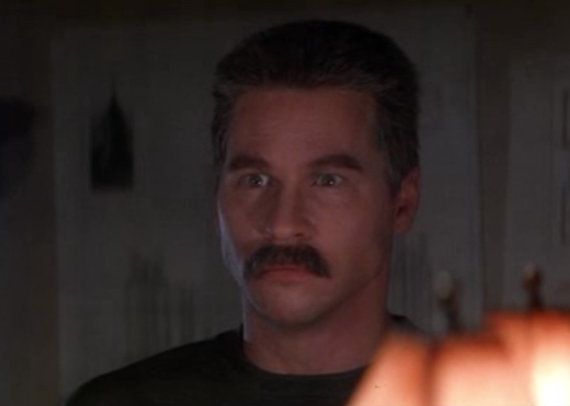
Anyway, The Saint goes like this: As a youth, Val Kilmer’s character is partly responsible for the death of a female classmate in an oppressive Catholic co-ed boarding school. He adopts a pseudonym, Simon Templar, taken from a comic book about the Knights Templar, and develops a fetishistic attachment to Catholic saints. In later life he is a professional thief who relies more on the inadequate security infrastructure and general incompetence of his targets than any obvious skill or athletic prowess of his own. After stealing a Pentium processor from the vault of a Russian crime lord (who strangely resembles Yanni) while rocking an unintentionally gay moustache, Simon actually takes a job from the Yanni chap, for reasons I'm not sure are ever explained.

Unintentionally gay.
Kilmer’s assignment: To steal the unfinished formulas for Cold Fusion developed at Oxford by Elisabeth Shue, whose irresistible school-marm charm makes her a welcome presence on the screen while at the same time ensuring that she is the last person you’d ever peg as the world’s leading physicist. (And everything was so plausible up to this point!) Kilmer seduces Shue while disguised as what appears to be The Beast from the Walt Disney production and steals the most important scientific discovery of the 20th Century from her undergarments. (And no, I’m not talking about the female orgasm, as that’s still obviously a myth.) Yanni wants the Cold Fusion formulas to convince the Russian people- who are currently freezing due to a purported lack of natural resources for heat production- that only the Russian Mafia is capable of giving them what they need. What happens after that you can probably write yourself- and even if you’re completely wrong, it wouldn’t be any less exciting than what actually transpires onscreen.

Seriously, the (very few) action sequences in this film are both short and uninspired. Roger Moore, of all people, should have known that people come to these films to be wowed by suspenseful chases and whimsical gadgets. Wait- on second thought, perhaps Moore wasn’t the right guy to be shepherding this project after all. Have we forgotten Moonraker?


Anyway, Jason Bourne this ain’t. Speaking of Jason Bourne- have you seen those movies? They’re actually quite good. Especially the last two, directed by Paul Greengrass. I hear Greengrass is working on a film about the last days of Martin Luther King, to be done in the real-time style of his earlier films, Bloody Sunday and United 93. Oh, I’m supposed to be talking about The Saint still, aren’t I? Sigh.

Val Kilmer dons silly costumes and speaks in silly accents throughout the film. Unfortunately it is less Fletch and more Master of Disguise in execution. As miscalculated as Kilmer’s accents are, however, they still can’t touch Leonardo DiCaprio’s bizarre turn in Blood Diamond for sheer WTF:


One remarkable thing about the picture is that the soundtrack is a sort of time capsule for some of the best of mid-90s Electronica. Sadly, the songs appear to be a mere contractual obligation to sell some soundtrack CDs; none of them feature in the film for more than a few seconds, and they’re all mixed deep into the sonic background.

So, The Saint. Was it great? Nah. Was it exceedingly mediocre and inoffensively bland? You bet your ass it was.

Wednesday, December 15, 2010

Worst Impressions

“Friggen lightweight,” I sneer silently as the skinny blonde with the loud pants half-assedly plods on the elliptical machine, a hot-pink smartphone pressed to her cheek. Eight minutes later she’s gone, and my geek’s mind involuntarily calculates exactly how few calories she just burned and how infinitesimally little her abbreviated romp on the machine just affected her fitness. My eyes roll, but I’m not surprised. I’m never on the cardio floor for fewer than sixty-five minutes, and everyone who’s there when I first arrive has left by the time I step off the treadmill. Hell, anyone who gets there within half an hour of my starting will have vanished before I’m done. I arrive first and leave last.

Forty minutes later I’ve made a quick trip to the locker room to stow the iPod, refill the water bottle, and retrieve my log book and stopwatch. I make my way over to the dumbbell corner and am startled to find The Blonde standing there, facing the window. My surprise quickly boils to annoyance when I spy a small pile of equipment at her feet, including the dumbbells- my dumbbells- I always use during my routine: The 10-pound polygonals; the ones that don’t roll away when you’re supporting yourself on them. I shoot her with some hollow-point eye bullets before grumbling and begrudgingly yanking the next-heaviest weights from the rack.

While I’m scribbling down my workout plan in the log book, Blondie pulls a 2-foot-high stool from the wall and begins hopping sideways onto the thing, back and forth- with perfect form- over and over again. It doesn’t sound like much, perhaps, but the average person would be lucky to do five of these things (if any) without beginning to flail like an idiot. I harrumph and begin with a set of goblet squats.

A while later I’m doing some mountain climbers and wondering, as my face burns and the blood pressure in my head throbs to a migrane-level crescendo, if this is what it feels like to be trapped in a microwave oven before your skull explodes. I hear a delicate feminine grunt to my left and glance over to see The Blonde doing pushups with her feet suspended from an overhead bar. She’s pushing her full body weight, her face expressionless and calm. It occurs to me that her few minutes on the elliptical had been a warm-up, whereas half the people who come here would consider that the main event. Hell, she probably sleeps on a treadmill, I’m thinking.

A few minutes on and I’m working through my second set, groaning through some increasingly laborious dumbbell rows when behind me I hear a racket not dissimilar to what Ebeneezer Scrooge must have heard when Jacob Marley first shuffled into that dark bedroom. I peek around to spy That Damned Blonde dragging a hundred and fifty pounds behind her on a chain. “Who ARE you?” I ask telepathically.

I’m soon struggling through my second round of T-pushups and my muscles are inching toward failure. “Please let me just finish out this minute,” I beg my shoulders, and they grant me just enough juice to reach the 59-second mark, at which point I crumple to the floor and fumble for the stopwatch. My water bottle empty, my shirt towel-wet with sweat, I replace my weights and collect my things. And for the first time since I’ve been doing this I am the last to enter and the first to leave.

Forgive me, Aryan she-hulk of the Northwest- for I knew not your prowess.

Sunday, July 18, 2010

Trolling Done Right

If you are not entrenched in Internet culture and all the memes and jargon it entails, it is quite possible that nothing after this sentence will make any sense to you at all- and really, you’re probably better off. But if you are the kind of person who understands why Philips CD-i Zelda is the cancer that is killing YouTube and who shudders whenever anyone posts that X Y is X, you may appreciate this tale about how some guys with a grudge, some talent, and a lot of time on their hands colluded to execute one of the most (literally) epic trolls in recent history.

Our story begins on Newgrounds, an online community where aspiring animators, programmers, and voice actors collaborate to create online cartoons and games. One of the most well-known personalities to frequent Newgrounds is Rina-chan, a GOTIS victim, USI-sufferer, and actress who has voiced “literally thousands of characters in online animated shorts, series and games.” She has done a small amount of professional voice work and formed her own association of Internet voice actors, the Voice Acting Club (VAC).

In early 2008, Rina-chan (a.k.a. RunkaChunk) collaborated with an animator called Kirbopher to create a terrible Flash animation called Brawl Taunts. The cartoon puts characters from Nintendo’s Super Smash Bros. Brawl (a sort of Nintendo All-Stars melee fighting game) into wacky situations and, for some reason, takes potshots at Sega- at least 8 years since that company ceased to be a presence on the console gaming scene. The jokes were uniformly unfunny, the animation uninspired, and like all awful things, it quickly developed a large borg-like following.


The first Brawl Taunts went over so well that Rina-chan and Kirbopher shat out two subsequent installments (More Brawl Taunts and One More Brawl Taunts), using a very familiar formula: Consecutive bad jokes with no relation to each other + puns + pop culture references + Internet memes = shitty Flash. Rina-chan’s already inflated ego loomed large over the Newgrounds landscape.

The undeserved praise that the masses heaped on Brawl Taunts raised the ire of Newgrounds user ChainsawDentist (he has since changed his username to Spazkid), so he and a couple of friends responded with Brawl 4, a spoofed fourth entry into the Brawl Taunts canon. It was annoying and pretty bad, but it also used unflattering real-life photographs of both Rina-chan and Kirbopher and directly mocked some of the bits from the original series. It should be noted that by most accounts Rina-chan is not fat in real life, and it’s likely the Brawl 4 guys were aware of this. They probably just made her look huge in the video for laughs... but with this artistic decision they were about to tap into a deep well of lulz.) Even though Brawl 4 wasn’t exactly good, it struck a chord with a quiet minority of Newgrounds users and gained enough user ratings to appear on the Newgrounds front page... which is how Rina-chan first learned of its existence.


ChainsawDentist took note and disappeared into the shadows, while Rina-chan teamed up with an animator by the name of Scoot on a completely new concept: Do a movie exactly like Brawl Taunts, but with characters from Capcom’s Street Fighter games instead!!!


Street Fighter Club soon debuted to great reviews from the unenlightened Newgrounds masses. Obviously Rina-chan hadn’t taken ChainsawDentist’s message to heart. She probably had no way of knowing that she had just awakened the sleeping dragon of lulz.

Over the next seven months, ChainsawDentist and a small team of comrades toiled in dorms and basements assembling a sprawling epic of a response to Street Fighter Club. Whereas all of the aforementioned movies, including Brawl 4, were collections of mini sketches with no narrative connective tissue, the new film was an action-and-dick-packed thriller that followed a pair of Newgrounds moderators who were willing to risk it all to prevent Rina-chan and her cabal of Voice Acting Club associates from uploading another terrible movie to the site. The character design of the moderators was inspired by the militaristic iconography of the newgrounds website logos, while Rina-chan and the Brawl Taunts/Street Fighter Club staff were cast as disgusting supervillains, each with their own traits or powers.

The Newgrounds boys. They are not prepared.

On July 7, 2010, ChainsawDentist’s magnum opus, Street Fighter Chode, debuted on Newgrounds with an adult rating for language, violence, and lots and lots of cocks. Despite the adult content, Street Fighter Chode was an instant hit, quickly appearing on the front page and garnering a 9.5/10 rating with hundreds of votes. So, sit back, relax, and put your goddam headphones on before playing this video, because while it is a thing of perfect beauty, it is definitely not safe for work.